
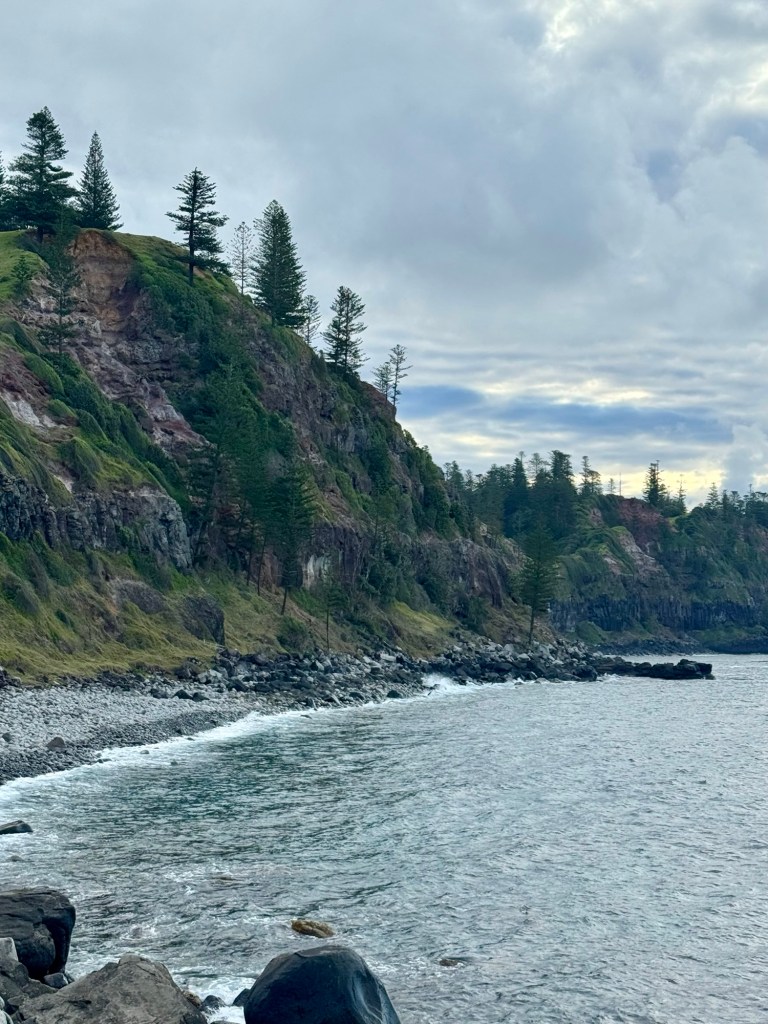
(L) Cascade Bay, site of the old whaling station. (B) Phillip Island in the distance from Mt Pitt.

Norfolk Island Pines were the dominate species when Captain Cook discovered the island in 1774. It wasn’t until Lieutenant Phillip Gidley King arrived under orders from Governor Arthur Phillip with convicts from Port Jackson in March 1788 that a settlement began. The Colony in NSW was on the point of famine and King was sent to grow grain & harvest Flax to make cotton. The fledgling colony in Sydney were living with poor sandstone soils that could’nt grow a successful crop. Norfolk had rich volcanic soils and ample tall pines for ship masts etc. The early convicts didn’t live in a prison as the Island was the prison. They were all busy cutting timber or producing food. The main settlement was close to the shoreline at Kingston (now UNESCO site) the best harbour point for unloading stores. But it was a difficult place to live with two close to shore reefs and often rough seas blocked access. The settlement lasted until 1814 when all the convicts were removed to Sydney NSW. The British returned in 1825 to establish a proper english style prison-it was a cruel brutal place to be a prisoner. One interesting fact I learned about this period was the early settlement was nearly wiped out by a series of Tsunamis as a result of earthquakes in New Zealand, a hazard of keeping everyone living close to the shore. The convict system lasted until 1856 when all the inmates were removed to Van Diemen’s Land (Tasmania).
The european history of the Island has some link back to the Mutiny on the Bounty with Captain Bligh story and Fletcher Christian. The Mutineers descendants were living on Pitcairn Island until life got too difficult and they partitioned Queen Victoria to be resettled somewhere. She obviously had a spare island up her sleeve and offered Norfolk Is to them in 1856. So they weremoved to Norfolk and a new era of settlement began. That’s enough on that. You can view a bit of Island History here.


Norfolk (Araucaria heterophylla)Pines occur across the Landscape. These pines were extensively planted along the coastal beaches of eastern Australia. They are very salt tolerant.
Today tourism is the main industry, mostly retirees from Australia & NZ seem to dominate. With support from local fishing and farming. The island is only 8km by 5km wide and the resident population is about 2,000. It is an Overseas Territory of Australia. Cattle roam the roadsides freely in many places under permit. It’s a great spot for birdwatching being on a shorebird flyway between the Arctic and NZ.
We weent for the birds and the scenery, its just magical.

Captain Cook Lookout.

Emily Bay, Kingston a great place for a swim.


 Walking Glenrowan and Beyond
Leave a comment